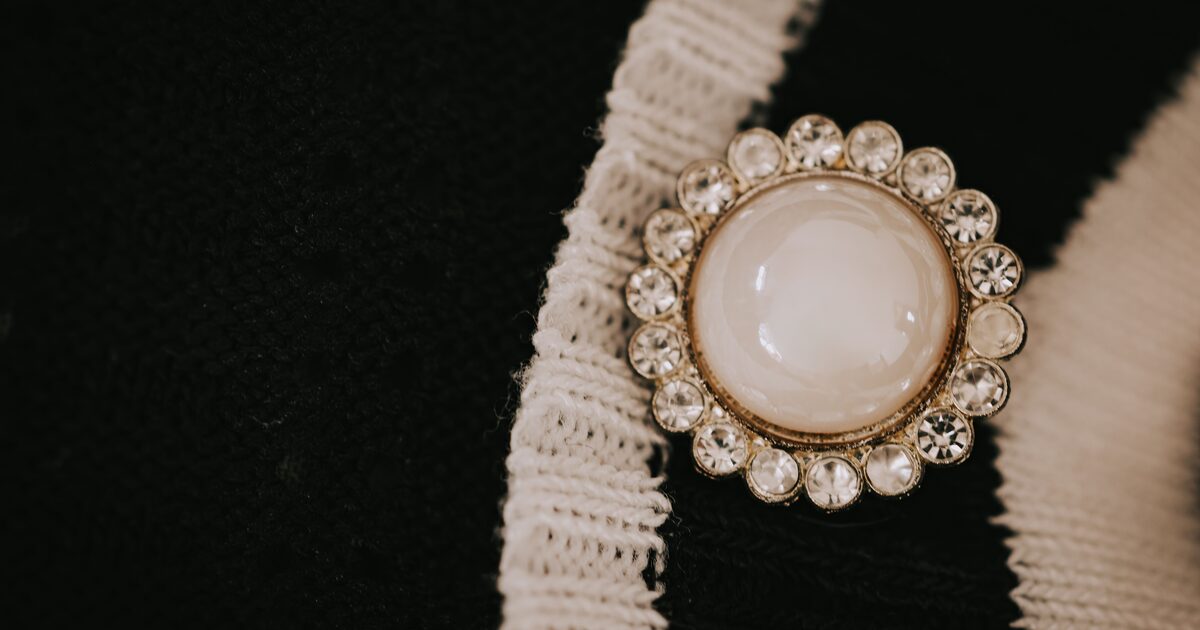
Before you sweep a shoebox of old brooches and clip earrings into the donate pile, turn one over and look for a name. Costume jewelry is made from base metal and glass, so its material value is close to nothing, yet a signed piece from the right maker can sell for hundreds. The reason is the whole answer to whether costume jewelry is worth anything: with these pieces, the signature often matters more than the materials.
Costume jewelry, also called fashion jewelry, is built from non-precious materials: base metal alloys, glass rhinestones, faux pearls, enamel, and plated finishes. That gives it little melt or gemstone value. But signed pieces from collectible mid-century makers such as Trifari, Weiss, Coro, Miriam Haskell, and Eisenberg can carry real resale value to collectors, driven by the maker’s mark rather than what the piece is made of.
Here is how to separate collector value from material value, why the mark leads, and exactly where to find it.
What is costume jewelry actually made of?
The materials are the reason the melt value is negligible. Under the FTC Jewelry Guides, terms like “gold” and “sterling” are reserved for real precious-metal content, which is why costume pieces are described as base metal, plated, or simply not marked with a fineness at all. Typical construction includes:
- Base-metal bodies such as brass, pot metal, or other white alloys.
- Glass rhinestones and “paste,” which the International Gem Society describes as the leaded-glass stones long used to imitate gems.
- Faux or simulated pearls, usually glass or plastic beads with a coating.
- Enamel, japanning (a dark baked finish), and thin gold or rhodium plating.
Melt those down and you have pennies. That is precisely why materials are the wrong place to start when you are deciding what a costume piece is worth.
Why the maker’s mark beats the materials
In fine jewelry, value tends to track the metal and stones. In costume jewelry it flips: the collector market pays for the maker, the design, and the era. A well-known designer’s rhinestone brooch, made from the same glass and base metal as an unsigned one beside it, can sell for many times more simply because it is signed and sought after. Collectors specialize in particular houses, chase complete sets, and pay premiums for scarce designs, so the name on the back is doing most of the pricing.
That is why the smart first move is not to weigh a piece or count its stones but to hunt for a signature. Names worth recognizing on mid-century American and European costume jewelry include Trifari, Coro (and its higher-end Corocraft line), Weiss, Eisenberg, and Miriam Haskell, among others. An unsigned piece is not automatically worthless, since strong design and quality construction still attract buyers and some makers can be attributed by their distinctive style, but a clear, collectible signature is the single biggest value signal you can find quickly.
One caution: marks can be faked or added, and a famous name does not guarantee a fortune, only a reason to research further rather than discard.
Where to find and read the mark
Signatures on costume jewelry are often tiny and tucked out of sight, so use good light and a loupe and check every likely spot:
- The clasp or closure. On necklaces and bracelets the maker’s name is frequently stamped on the clasp itself or on a small tag hanging beside it.
- The back of the setting. Brooches and pendants often carry the mark on the reverse plate, sometimes on a little applied cartouche or plaque.
- The pin stem and catch area. On brooches, look near the hinge and the C-clasp or safety catch; the style of catch also helps date a piece.
- Earring backs and clip mechanisms. Marks hide on the clip pad, the screw-back disc, or the post plate.
- Link edges and end tags. On bracelets, a maker tag is sometimes soldered as the final link.
Photograph the mark in context and then take a tighter close-up so you can search the exact spelling and any patent or copyright symbol. A circled letter c for copyright, for instance, generally suggests a piece made in 1955 or later, though it is a supporting clue rather than a firm date, since reissues carry it too.
Condition, completeness, and honest value labels
Even with a great signature, condition and completeness move the price hard. Buyers pay most for pieces that are clean and whole, so check for:
- Missing or replaced rhinestones, and stones that have gone dark or “dead” from lost foil backing.
- Plating loss, corrosion on pot metal, and cracked or chipped enamel.
- Working clasps, tight hinges, and intact pin stems.
- Complete sets. A matching parure or a brooch-and-earring demi-parure, sold together, is worth more than the same pieces split up.
Now label the value plainly, because two different numbers are in play. Material value, the melt-and-stones figure, is near zero for costume jewelry. Collector or resale value is what a buyer will pay for the object because of its maker, design, era, condition, and completeness, and that is where the money is. A signed, mint, complete set can be genuinely valuable as a collectible while being worth almost nothing as scrap. The broader logic of why one piece outsells another is laid out in what makes jewelry worth more.
Two footnotes keep expectations honest. Some “costume” pieces are actually gold filled or gold plated over a base or silver core, which carries a little real metal value, a distinction worth checking using gold filled vs gold plated; if that core turns out to be sterling, how much sterling silver is worth per gram puts a number on it. And if these pieces came to you in an estate, work through them methodically rather than in a rush, following what to do with inherited jewelry before anything leaves the house.
To sort a pile quickly, scan each piece with GemPeek: it flags the likely type, visible materials and stones, style era, and condition, and gives an estimated value range you can treat as a starting point, then confirm signed or promising pieces against sold comparables and, where it matters, a specialist, using the jewelry value guide.