A drawer of inherited flatware, a chain from a house clearance, a heavy tray that has gone dark at the edges: all of it looks like silver, and none of it comes with paperwork. The good news is that how to tell if silver is real is one of the few jewelry questions where a handful of five-minute checks get you most of the way, because silver announces itself through its marks, its magnetism, and the way it moves heat.
Start with the stamp. Real solid silver is marked with a fineness number such as 925, 800, or 958, or the word sterling. Marks containing EP, EPNS, EPBM, A1, or the phrase silver on copper are plating codes, meaning a thin silver skin over a base metal. If the mark is missing or ambiguous, a magnet, an ice cube, and finally an acid or XRF test settle it.
Here is how to read each of those signals, and where each one stops being reliable.
What marks does real silver carry?
Solid silver is almost always marked, because the trade has stamped fineness for centuries. The number is parts per thousand of pure silver:
- 925 / sterling / ster is 92.5 percent silver, the standard you will see on most silver jewelry and flatware sold in the US and UK. If you want the full story on that stamp, see what does 925 mean on jewelry.
- 800, 830, and 900 are continental European standards, common on German, Italian, and Scandinavian pieces. They are genuinely silver, just less of it per gram than sterling.
- 958 is Britannia silver, a higher standard than sterling. Do not confuse it with Britannia metal, which is a tin alloy and contains no silver at all.
- 999 or fine silver is bullion-grade silver, usually seen on rounds, bars, and some modern chains.
British pieces go further than a single number. A UK hallmark is a set of marks struck by an independent assay office after the metal has actually been tested, and The Assay Office describes the compulsory components as a sponsor’s mark identifying who submitted the article, a fineness mark giving the silver content in parts per thousand, and the assay office mark showing where it was tested. Many pieces also carry a date letter, which is why a British hallmark can often be dated to a specific year. That combination is the strongest evidence a home inspection can produce, because it means a third party assayed the metal rather than a maker simply claiming it.
In the US, the naming side is regulated rather than assayed. The FTC Jewelry Guides set out when a product may be described and marked as silver or sterling, which is why a domestic sterling piece typically carries the word plus a maker’s mark rather than an office punch. No stamp is proof on its own, since marks can be faked or transferred, but a mark that matches the metal’s behavior in the tests below is a strong result.
The plating alphabet: EP, EPNS, EPBM, A1 decoded
This is where most people get caught, because plated goods are marked with confident-looking letters that read like a standard. They are not. Every code below describes a silver coating measured in microns over a base-metal body:
| Mark | What it actually means | Silver in the body | Melt value |
|---|---|---|---|
| EP | Electroplated: a deposited silver layer over base metal | None | Essentially none |
| EPNS | Electroplated nickel silver: silver plating over a nickel silver body | None | Essentially none |
| EPBM | Electroplated Britannia metal: silver plating over a tin-based alloy | None | Essentially none |
| A1, A1 quality | A plater’s quality grade for a heavier deposit, not a fineness standard | None | Essentially none |
| Silver on copper | Silver plating over a copper body | None | Essentially none |
| Nickel silver, German silver, alpaca | A copper, nickel, and zinc alloy named for its color | None | Essentially none |
| Silver plate, plated, quadruple plate | Generic plating descriptions | None | Essentially none |
Two things follow from that table. First, nickel silver and German silver contain no silver whatsoever; the name describes the color, not the content. Second, A1 is the most misleading mark in the drawer, because it looks like a grade of purity and is actually a plater’s claim about how thick the coating is. Heavier plating wears better, but it does not change the fact that the object underneath is nickel, copper, or tin.
None of this means the piece is worthless. Victorian and Edwardian EPNS tableware from a good maker, or a well-designed mid-century plated service, can sell for real money on design and condition alone. It just means the value lives in the object rather than the metal, and it will never be a melt story.
Does the magnet test work on silver?
Silver is not attracted to a magnet. If a piece snaps to a fridge magnet, it is not solid silver, though it may well be silver plate over a steel or iron body, which is common on cutlery blades and on cheap chains.
There is a better version of this test using a strong neodymium magnet. Tilt the piece at a shallow angle and let the magnet slide down its surface. On solid silver the magnet visibly slows and drifts rather than sliding freely, because the moving magnetic field induces eddy currents in the metal, which in turn resist the motion. Silver is the best electrical conductor of all the metals, so the braking effect is unusually pronounced. A thinly plated or non-conductive base-metal piece lets the magnet run down much faster; the one exception worth knowing is that copper and aluminum are also strong conductors and can show a milder version of the same drag, so a slowed slide on an unmarked piece is a good sign rather than final proof. It is a qualitative check rather than a measurement, but it is convincing on flat surfaces such as trays, ingots, and the backs of flatware, and it is the same class of test as the density and magnet checks described in how to tell if gold is real.
The ice test, and where it stops working
Silver is also the best thermal conductor of the metals, which is the basis of the ice test. Put an ice cube on a silver surface at room temperature and it melts noticeably faster than it would on steel, pewter, or a plated base metal, because the silver pulls heat into the cube from the whole surrounding mass of the object.
Be honest about the limit: the test depends on there being enough metal to act as a heat reservoir. A thin ring, a light chain, or a pair of earrings simply does not have the mass for a clear result, and you will end up staring at two ice cubes convincing yourself you can see a difference. It works well on flatware, trays, bowls, and hollowware, and it works poorly on most jewelry. Use it where the object is heavy, and ignore it where it is not.
What tarnish tells you
Real silver tarnishes. It reacts with sulfur compounds in ordinary air to form silver sulfide, which darkens the surface through yellow and brown to near black. A piece claiming to be silver that has lived in a drawer for decades and is still perfectly bright is worth a second look, since some bright base metals and rhodium-plated pieces will not darken at all.
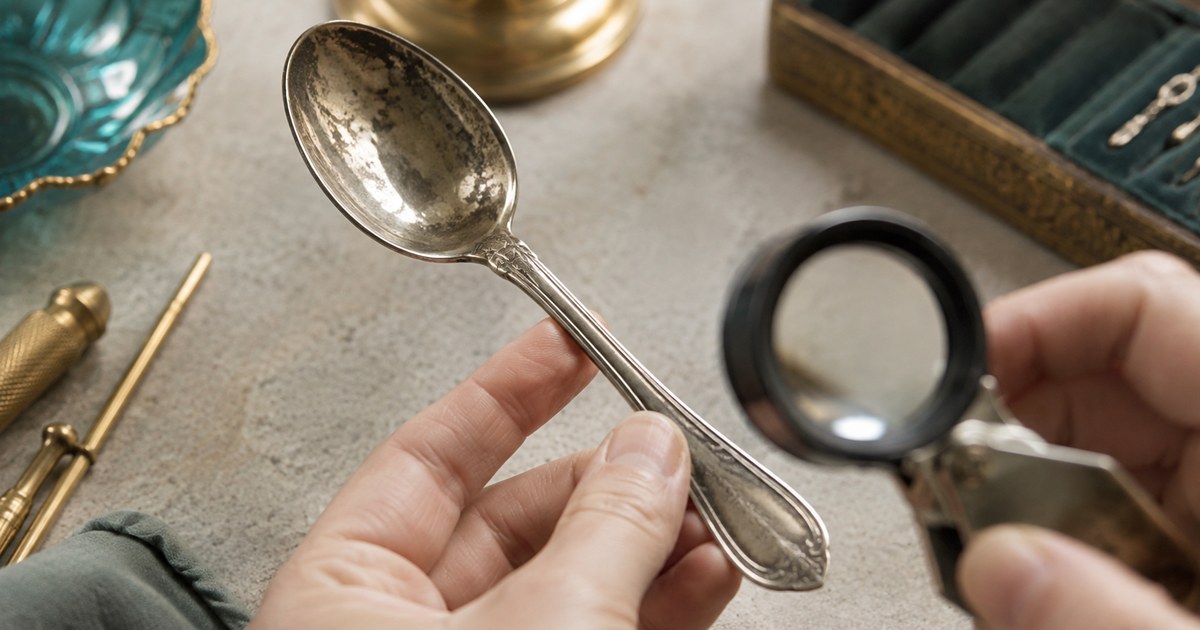
The more useful signal is how the tarnish is distributed. On solid silver the darkening is even, and it follows the recesses where polishing cloths cannot reach. On plated goods, the high points wear through first, so look at the edges of spoon bowls, the tips of fork tines, the handles of trays, and the shoulders of a ring. When the plating fails you see a different metal underneath: yellow brass, orange copper, or a flat grey nickel showing through the silver. That two-tone wear pattern is one of the clearest plating tells there is, and no amount of polishing hides it.
How to tell if silver is real for certain: acid and XRF
The checks above narrow it down. Two tests close it.
An acid test kit is the cheap definitive answer. You file or scratch a small area in an inconspicuous spot, apply a drop of the test solution, and read the color reaction against the kit’s own chart, which distinguishes sterling from lower standards and from base metal. The critical detail is that the scratch has to cut through any plating into the body of the piece, otherwise you are testing the coating and getting a false positive. It is destructive by design, so choose the underside of a foot, the inside of a band, or the back of a handle.
XRF analysis at a jeweler, pawnbroker, or refiner is the non-destructive version. The instrument reads the actual elemental composition rather than a color change, and many will run it while you wait. Its one weakness is that it reads the surface layer, so a heavily plated piece can return a silver-looking result. A reputable operator handles this by testing a filed or worn spot that exposes the body metal. Treat all of this as a strong first answer and confirm with a jeweler or an appraiser before you sell, insure, or scrap anything you care about.
The practical takeaway
Work in that order and you will rarely be wrong: read the mark, decode any letters against the plating table, check the magnet behavior, use ice only on heavy pieces, read the wear pattern at the high points, then pay for an acid or XRF test if the answer still matters. A stamp that says 925 on a piece that ignores a magnet, brakes a neodymium slide, melts ice quickly, and tarnishes evenly is real silver in every practical sense.
Once you know it is solid, the value question splits in two. Melt is the floor, driven by weight and fineness, and the arithmetic is laid out in how much is sterling silver worth per gram; silver prices move daily, so always check a live quote rather than a figure written in an article. Above that floor sits whatever the maker, age, design, and condition add, which is a different number from melt and a different number again from insurance replacement. The jewelry value guide explains which of those three you actually need before you start asking for offers.
For a fast first read on a piece whose mark is worn, cryptic, or missing entirely, scan it with GemPeek: it flags the likely type, the stamps and materials it can see, the finish and condition, and an estimated value range, so you know whether you are holding sterling worth weighing or plated ware worth keeping for its looks.