
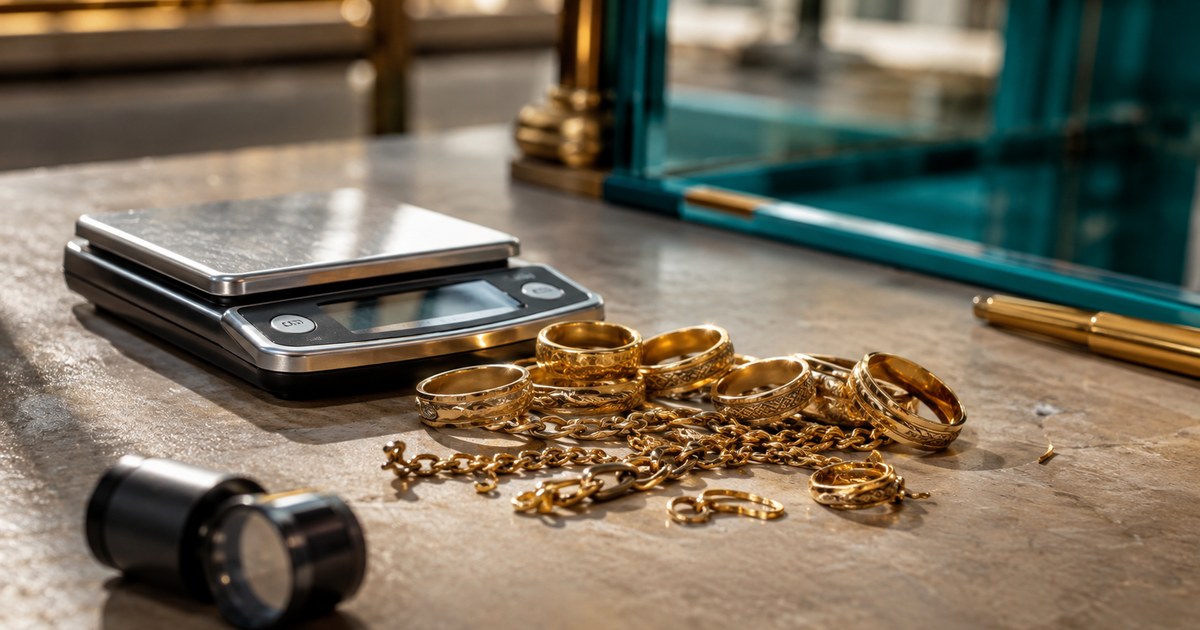
You have a broken chain, a single earring, and a ring nobody in the family wants, and the nearest counter that will hand you cash today is a pawn shop. The question of how much do pawn shops pay for gold feels like it should have a price-per-gram answer, but it does not, because the offer is assembled in front of you from three inputs you can check yourself before you ever walk in.
A pawn shop’s gold offer is built from melt value, not retail price. The shop tests the karat, weighs the gold alone, multiplies weight by karat fineness by the day’s gold price per gram, then offers a percentage of that figure. The percentage varies by shop, item, and lot size, so ask what theirs is.
Here is the arithmetic to run at your kitchen table, the exact questions to ask at the counter, and the pieces you should never scrap.
How much do pawn shops pay for gold: the melt math behind the offer
Every gold offer, at a pawn shop or anywhere else, starts from the same calculation:
Melt value = weight in grams x karat fineness x gold price per gram
Three inputs, all of which you can establish before you leave the house.
Karat fineness is the fraction of the alloy that is actually gold, and the stamp tells you which factor to use:
| Stamp | Karat | Fineness factor |
|---|---|---|
| 417 | 10K | 0.4167 |
| 585 | 14K | 0.5833 |
| 750 | 18K | 0.750 |
| 916 | 22K | 0.9167 |
| 999 | 24K | 1.000 |
Those parts-per-thousand numbers are the international convention behind hallmarking, described by The Assay Office, and in the United States a false karat claim on a piece sold as gold is the kind of unfair or deceptive practice the FTC Jewelry Guides address. Some buyers use 0.585 for 14K because that is what the 585 stamp guarantees rather than the exact 0.5833 arithmetic; on a small lot the difference is pennies, so do not argue about it.
Gold price per gram is not the number you see quoted in the news. Gold trades per troy ounce, and one troy ounce is 31.1035 grams, so divide the quoted spot price per ounce by 31.1035 to get the per-gram figure. Look this up on the morning you go. The price moves every trading day, which is exactly why nobody, including this article, can tell you what a gram of your gold is worth in advance.
Weight in grams means the weight of the gold and nothing else, which is where most home estimates go wrong. For a full worked example with numbers plugged in, see how much is 14k gold worth per gram.
Once the shop has that melt figure, they offer a share of it. The offer sits below melt because refining, assaying, the risk that the gold price drops before they can move the lot, and the shop’s own margin all come out of the gap. There is no published, authoritative payout figure for pawn shops, and anyone quoting you one as an industry standard is guessing. What moves it is real enough: the shop, the karat, how much you are selling at once, whether the piece can be resold as jewelry instead of scrapped, and how many competing buyers are within driving distance.
What gets weighed out of the total
The scale does not know what is gold and what is not, so the tester has to subtract. Expect these to come off your estimate:
- Gemstones. Stones are weighed out or the piece is quoted with an allowance for them. A scrap buyer is not paying you for the stone, and their value is a separate question entirely.
- Clasps, springs, and pins. Spring rings, clasp mechanisms, and earring backs are often base metal or a lower karat even on a solid gold piece, and an unmarked finding gets treated as not gold.
- Solder, filler, and hollow construction. Repaired joints and the filler inside hollow bangles are not fine gold, and hollow rope chains, puffed hearts, and tube hoops look substantial while weighing very little. A chain that reads as heavy on the wrist can come in at a fraction of what its size suggests.
- Anything plated or filled. A gold tone that is a coating over brass has essentially no recoverable gold. Confirm what you actually have first using how to tell if gold is real, because a 585 stamp on plated base metal is a stamp on base metal.
Weigh your pieces at home on a scale that reads to a tenth of a gram, sort them by karat stamp, and calculate each group separately. Walking in with your own number is the entire advantage.
The four questions to ask at the counter
This is the part that turns a vague “shop around” into something you can actually do. When an offer lands in front of you, ask these, in this order:
- “What karat did you test this at, and how did you test it?” Acid testing, an electronic conductivity tester, and XRF each have different reliability, and a stamp read with the naked eye is not a test at all.
- “What weight did you get, and can I see the scale?” A reputable buyer will show you the display and tell you what they excluded and why.
- “What gold price per gram are you using today?” Check it against the live spot price divided by 31.1035. If their per-gram figure is far off, that difference is coming out of your side.
- “What percentage of melt is this offer?” This is the question that reveals the whole structure. A shop that pays a modest share of melt and says so plainly is being straight with you. A shop that will not name a figure is telling you something.
Ask the same four questions at a second counter and you have a genuine comparison rather than two disconnected numbers. Get the offer in writing before you hand anything over, and remember that you can decline and leave with your jewelry.
A pawn loan and an outright sale are two different transactions
People use “pawn” for both, and the numbers are not interchangeable.
An outright sale ends the relationship. You hand over the gold, take the money, and the shop owns it.
A pawn loan is a short-term loan secured by your jewelry as collateral. You get cash now, the shop holds the piece, and you repay the principal plus interest and fees within the loan term to get it back. If you do not redeem it, the shop keeps and sells the item, and in most places that closes the debt rather than leaving you owing more. Interest rates, fees, terms, and default rules are set by state and local law and vary widely, so read the pawn ticket rather than trusting a number you read online.
The loan amount is usually lower than what the same shop would pay to buy the piece outright, and that is not a trick: the shop is fronting cash on an asset whose price can fall, storing and insuring it, and accepting that it may never be redeemed, so the loan is written with a wider cushion. Decide which transaction you want before you ask for a number, because comparing a loan offer at one shop against a purchase offer at another tells you nothing.
When the piece is worth more intact than melted
A scrap buyer prices metal. That is the job. But some pieces are worth a multiple of their melt value as objects, and once they are melted that value is gone permanently. Set these aside before anything goes in the scrap pile:
- Signed and designer pieces. A maker’s mark, a signature, or a recognized house name can carry the piece far past its metal content.
- Antique and period settings. Hand-fabricated mountings, old cutting styles, and era-specific construction have their own market. Vintage and estate jewelry is bought by people who want that, not by refiners.
- Anything with significant gemstones. Good diamonds and colored stones are valued independently of the mounting, and a melt quote ignores them or lowballs them.
- Collector categories. Watches, certain mid-century designers, regional silverwork, and pieces with documented provenance trade on demand for the object.
If you suspect a piece falls into one of these, that is the moment a professional opinion earns its fee. How much does a jewelry appraisal cost covers when paying for a formal valuation makes financial sense and when it does not.
Where else gold gets sold
A pawn shop is one option among several, and the trade-off is almost always speed against price:
- Dedicated gold buyers and refiners. Closer to the metal supply chain, and bulk sellers often do better here, though minimums and mail-in terms apply.
- Jewelers who buy. Some will buy scrap, and a jeweler is more likely than a refiner to recognize a piece worth reselling intact.
- Consignment. A shop sells the piece on your behalf for a cut. Slower, but it reaches buyers who want jewelry rather than metal.
- Private and auction sale. The highest ceiling for distinctive pieces and the most work, with fees, timelines, and no guarantee of a sale.
None of these is automatically the right answer. The choice depends on whether you need cash today or the best number available.
The practical takeaway
Run the melt math before you go: weight in grams, times the fineness factor for the stamp, times today’s spot price divided by 31.1035. That figure is melt value, the metal content and nothing else. Resale value is what the piece fetches as finished jewelry, close to melt for a plain chain and far above it for a signed or antique one. Retail replacement value is what it costs to buy new and is always the highest of the three, which is why an insurance figure never predicts an offer. The jewelry value guide walks through choosing the right one for your situation.
Bring your own number, ask the four questions, keep the loan and sale conversations separate, and pull anything signed, antique, or gem-set out of the pile before you scrap it.
Before you sort your jewelry into scrap and keep, scan each piece with GemPeek for a fast first read: it flags the likely type, visible marks and materials, condition, and an estimated value range, so you can see at a glance which pieces are plain metal and which deserve a closer look from a jeweler before anyone melts them.