
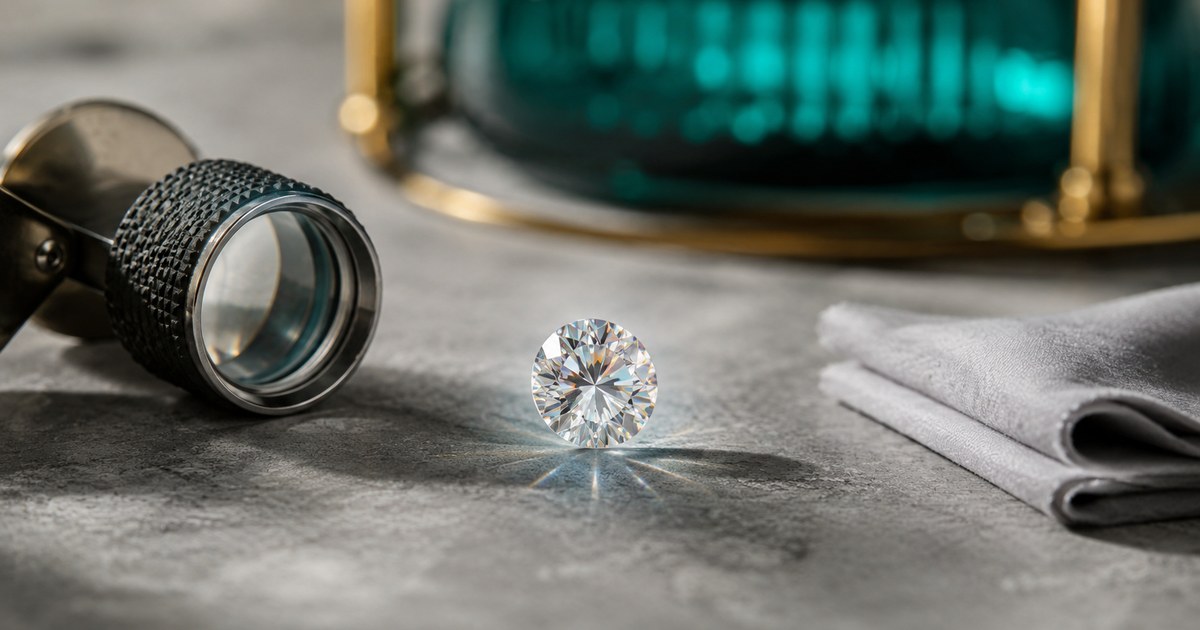
A ring turns up in a drawer, an estate box, or a thrift-store tray, and the stone flashes like it means it. Before you pay for an appraisal or list it for sale, it helps to know how to tell if a diamond is real, and just as important, which of the famous home tests are not worth your time.
No single home test proves a diamond is real, but a few checks are genuinely useful: trying to read print through the stone, inspecting the girdle for a laser inscription, and reading the quality of the setting. The popular fog, water, and scratch tests are unreliable, and thermal tester pens will happily pass moissanite as diamond.
Below, the checks ranked from most to least reliable, plus the specific tells for the two look-alikes you are most likely to meet: cubic zirconia and moissanite.
Start with what a diamond actually is
Diamond is crystallized carbon and the hardest natural material known, a 10 on the Mohs hardness scale. That hardness is why diamond facet edges stay crisp for decades while softer imitations round off and scratch. Diamond also bends light strongly and conducts heat unusually well. Every legitimate home check exploits one of those three properties. Every unreliable one misunderstands them.
The most reliable home checks
Look for a laser inscription on the girdle
Many laboratory-graded diamonds carry a microscopic report number lasered onto the girdle, the thin band around the stone’s widest point. GIA and other major labs inscribe report numbers that can be matched to an online report. Tilt the stone under strong light with a 10x loupe and scan the girdle slowly. Finding an inscription that matches a real grading report is the closest a home check gets to proof. Not finding one proves nothing, since plenty of genuine diamonds, especially older ones, were never inscribed.
The read-through test, done properly
Place a loose stone flat side down over a line of newsprint or small printed text. A well-cut round brilliant diamond bends light so sharply that you should not be able to read the print through it; you will see only sparkle and fragmentation. Cubic zirconia and glass often let letters show through, sometimes clearly enough to read.
Two honest caveats. The test only works on loose or shallow-set stones you can lay over the page, and certain shapes and very shallow cuts can leak light even in genuine diamonds. Treat a readable stone as a red flag, not a verdict.
Read the setting like an appraiser
Real diamonds are rarely set in junk. Check inside the band for metal fineness marks: 10K, 14K, 18K, 585, 750, 950, PLAT. A substantial stone in unmarked, discolored, or obviously plated metal is a warning sign, because nobody mounts a valuable diamond in throwaway metal. Prong quality tells the same story: crisp, well-finished prongs suggest a jeweler who was protecting something. Our ring identification guide walks through reading settings, marks, and construction in detail.
Inspect the stone under magnification
Under a 10x loupe, natural diamonds usually show tiny internal characteristics: pinpoints, feathers, small crystals. Flawless stones exist but are rare and expensive. A large, perfectly clean, perfectly bright stone in a modest setting is far more likely to be CZ than a flawless diamond. Also study the facet edges: diamond’s hardness keeps edges knife-sharp, while worn CZ shows rounded edges and surface scratches.
The famous tests that are weaker than you think
- The fog test. Breathe on the stone; a diamond supposedly clears instantly because it disperses heat. In practice the result varies with room temperature, humidity, stone size, and dirt, and moissanite also conducts heat well. Too noisy to trust.
- The water test. A real diamond sinks. So do CZ, moissanite, glass, and nearly every stone heavy enough to set in a ring. The test rules out almost nothing.
- The scratch test. Dragging a stone across glass proves little, because moissanite, sapphire, and even some hard imitations scratch glass too, and you risk damaging a genuine stone or its setting. Skip it entirely.
- Thermal tester pens. Cheap “diamond testers” measure heat conduction, and they are useful for catching CZ and glass. But moissanite conducts heat like diamond does, so a basic thermal pen passes moissanite as diamond. Combination testers that also measure electrical conductivity exist for exactly this reason. A pass from a thermal pen means “diamond or moissanite,” not “diamond.”
CZ and moissanite are different problems
The two common look-alikes fail in different ways, so check for both.
Cubic zirconia is the easier catch. It is noticeably heavier than diamond for the same size, softer, and it wears its age: rounded facet edges, scratches, and a dulling surface after a few years of use. It is also usually too perfect internally, with none of the tiny inclusions natural diamonds tend to carry.
Moissanite is the harder catch. It is nearly as hard as diamond, passes thermal pens, and looks convincing at arm’s length. Its tell is optical: moissanite is doubly refractive, meaning light splits into two rays inside the stone. Under a loupe, look through the crown at the pavilion facets; in moissanite the back facet edges appear doubled, like faint ghost images. Diamond is singly refractive, so it does not produce that doubling; faint strain effects exist in some diamonds, but nothing like the obvious ghosted edges moissanite shows. Moissanite also throws more intense rainbow fire than diamond, a fireworks effect that reads slightly “too much” once you have seen both side by side. Our side-by-side on moissanite vs diamond walks through the doubling and the fire in more detail, including why the thermal pen is the wrong tool for this one.
None of the checks above apply if the stone in question is not colorless and faceted in the first place. An opaque blue or blue-green cabochon calls for a different set of tests entirely; see how to tell if turquoise is real if that is what is actually in the setting.
What to do with a maybe-diamond
Work the evidence in order: inscription, read-through, setting marks, loupe inspection. Photograph everything as you go, especially any girdle inscription and metal stamps, using the angles in our guide to photographing jewelry for identification. Clear photos are also what let GemPeek give you a useful first read: scan the piece and the app returns the likely stone identity, setting style, visible marks, condition notes, and an estimated value range. For a stone where serious money is on the line, treat any home result, including ours, as the informed first answer and have a gemologist or certified appraiser confirm it before you sell or insure.
Remember that “real” is only the first question. A genuine diamond’s value still swings enormously with cut quality, color, clarity, and carat weight, and with whether it carries a grading report. Our breakdown of what makes jewelry worth more covers those levers, and the guide to what your jewelry is worth explains which value number (retail, resale, or insurance replacement) actually applies to your situation.
The bottom line on how to tell if a diamond is real
Skip the fog, water, and scratch tests. Hunt the girdle for an inscription, try the read-through test on loose stones, read the setting’s metal marks, and loupe the stone for inclusions and doubled facets. Those four checks catch most CZ immediately and flag moissanite for closer testing, which is as far as home methods can honestly take you.