
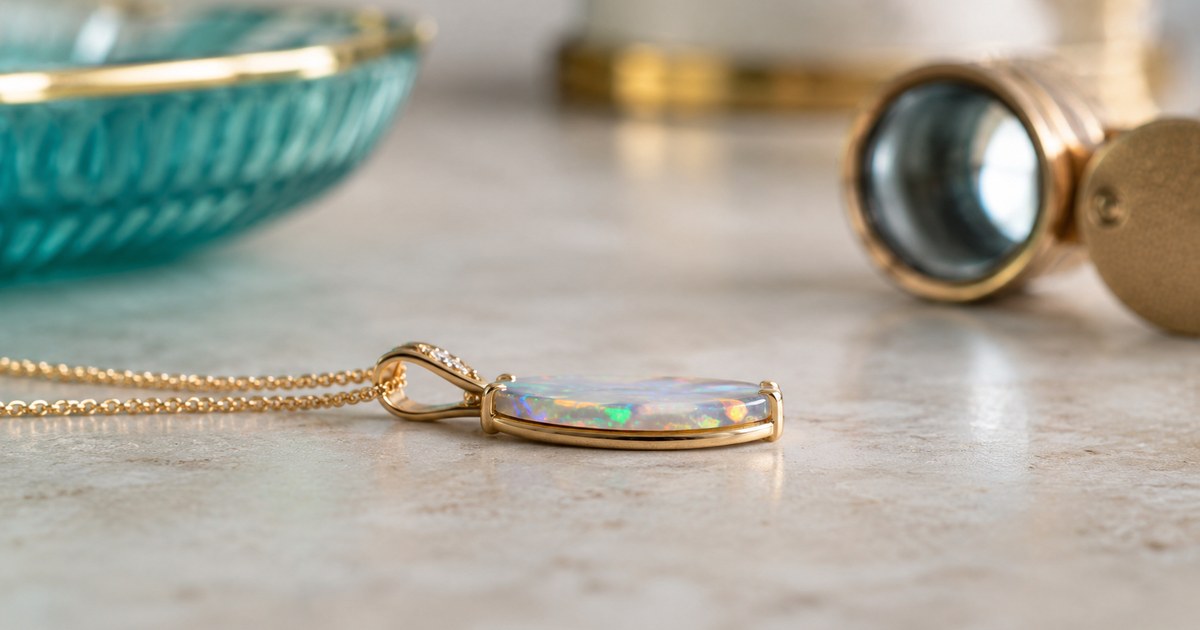
An opal arrives in a ring or a pendant, the color flashes green and orange as you tilt it, and you want to know what you are holding before you insure it, list it, or pay for an appraisal. How to tell if opal is real is the phrasing everyone searches, but real and fake is the wrong shape for this stone. Most opal disappointment does not involve a fake at all. It involves a genuine sliver of opal glued into a layered assembly that is worth a fraction of what the buyer thought.
View the stone edge-on. A solid natural opal shows the same material through its full thickness with an irregular natural boundary. A dead-straight join line means a doublet, and that same flat join under a clear domed cap means a triplet. A too-regular columnar structure or snakeskin color patterning points to lab-created opal instead.
Here is how to read each of those four answers, and what each one means for value and care.
What is opal, and why does it flash color?
Opal is a hydrated silica. Unlike most gems it is not crystalline, and it carries a variable amount of water inside its structure, which is the root of nearly everything else that is true about it. The GIA Gem Encyclopedia describes the play-of-color as a diffraction effect: opal is built from an ordered array of microscopic silica spheres, and when those spheres are uniform enough and stacked regularly enough, they split light into the moving patches of spectral color that make the stone famous. Opal without that ordered structure has no play-of-color and is called potch, which is common, cheap, and often used as the dark backing in assembled stones.
Two consequences matter for identification. First, hardness: opal is commonly given as roughly 5.5 to 6.5 on the Mohs scale, which is soft for a stone worn on a hand. Anything harder, including ordinary household dust, can abrade it, which is why opal in a daily-wear ring often shows fine surface scratches and a dulled polish that a harder stone would not. If your opal is set in a ring, the ring identifier guide covers how settings and wear patterns read on that piece. Second, water content: opal is sensitive to heat, to sudden temperature change, and to anything that saturates a glue line, which becomes decisive once assemblies enter the picture.
How to tell if opal is real: view the stone edge-on
The single most useful check needs no equipment. Turn the piece so you are looking at the stone from the side, level with the girdle, rather than down at the face. Good light and a loupe or phone macro help, but plain daylight is often enough.
- Solid natural opal shows the same material continuing through the full thickness of the stone. The boundary between the color layer and any host rock is irregular, wavy, and geological, because nature does not cut straight lines. Color often shows on the side of the stone too, not only on the face.
- A doublet shows a dead-straight, ruler-flat line partway down. Above it sits a thin slice of genuine opal; below it sits a dark backing, usually ironstone, potch, black glass, or plastic, cemented on to make the color read brighter.
- A triplet shows that same flat join plus a second layer: a clear domed cap of quartz, glass, or plastic sitting on top. The cap usually looks unnaturally glassy, and it flattens the color, so the play-of-color appears to sit under a window rather than to live inside the stone.
The catch is that bezel settings and closed-back mounts cover the girdle completely, which is exactly why so many owners learn about the join only when a jeweler unsets the stone or a buyer offers far less than expected. If the setting hides the edge, look for a color layer that seems suspiciously thin from every visible angle, an unusually flat and mirror-bright top surface, or a stone whose color stops abruptly at the metal.
Doublet or triplet? Both contain real opal
This is the part worth being clear about, because it is where most of the confusion sits. A doublet and a triplet are not fakes. The opal in them is genuine opal, often from the same fields as solid stones. They exist because precious opal frequently occurs in seams too thin to cut as a standalone gem, and an assembly makes that thin material wearable and affordable.
What changes is value. A solid opal and a visually similar doublet or triplet are not close in price, and the gap is large, because a solid stone is entirely gem material while an assembly is mostly backing and adhesive. Anyone valuing a piece needs the assembly question answered before any other number means anything. The broader logic of what moves a piece up or down is covered in what makes jewelry worth more.
Care changes too. That glue line is a weakness. Water can work into it over time, and when it does the stone fogs or clouds permanently: the color goes grey and milky, and there is no reliable way to reverse it. So an assembled opal should never go in an ultrasonic cleaner, never be soaked, and never be left in prolonged contact with water, which includes washing dishes, swimming, and long showers. A damp cloth and a dry one are the whole cleaning routine. Solid opals tolerate more, but they still dislike ultrasonic cleaners, steam, and abrupt temperature swings.
How to spot lab-created opal
Lab-created or synthetic opal, best known through the Gilson-type material and its successors, is grown rather than mined but built from the same silica-sphere structure that gives natural opal its play-of-color, which is why gemologists treat it as a distinct category from imitations rather than lumping it in with glass or plastic. Some synthetics do use a polymer to stabilize the structure, so “genuinely opal” is not a blanket guarantee across every product sold as lab-created; a lab is the only way to confirm the composition of a specific piece. At a glance, though, the tell is regularity, because a laboratory can build the silica sphere array more perfectly than geology usually does.
- Columnar structure seen from the side. Many synthetics show a repeating column or lath structure running through the stone, far too orderly to be natural.
- Snakeskin or lizard-skin patterning. The color patches form a regular scaled mosaic rather than the drifting, unequal patches of natural opal.
- Unnaturally uniform brilliance. The color play is bright and consistent across the entire stone, edge to edge, with none of the dead zones and thin patches that natural material almost always has somewhere.
Taken together those signals are usually enough to raise the question. Confirming it is different: separating a well-made synthetic from a natural stone is a gem-lab job, and a laboratory report is the honest endpoint for a piece where the answer carries real money. The same boundary between home observation and instrument work applies to every colored stone, and is laid out in how to identify a gemstone.
Imitations: opalite, glass, resin, and plastic
Below synthetics sit the true imitations, which contain no opal at all. Names like opalite are marketing terms for glass or resin, and the giveaway is that they have no true play-of-color. What they have is a milky internal glow that shifts between bluish and warm depending on whether light hits from the front or behind. Hold one still and tilt it: real play-of-color moves in discrete patches that switch on and off, while a glow simply brightens and dims.
Plastic imitations are easier still. Plastic feels warm to the touch almost immediately, weighs noticeably less than a stone of the same size, and frequently shows moulding seams around the girdle or trapped round bubbles inside. Glass often shows bubbles too, along with swirl lines and chipped rather than abraded edges.
None of this means treated or assembled material is worthless or dishonest, as long as it is described accurately. The same principle runs through how to tell if turquoise is real: genuine material that has been stabilized or backed is still genuine material, and the problem is only ever a solid-stone price attached to an assembled stone.
The practical takeaway
Stop asking whether the opal is real and start asking which of four things it is. Look at the stone from the side first, because that one view separates solid from doublet from triplet faster than anything else, and note that a bezel setting may be hiding the answer. Check the color for the regularity that flags a synthetic, and check for the flat glow, warmth, seams, and bubbles that flag glass or plastic. Then treat whatever you have as water-sensitive and softer than most gems, keep it away from ultrasonic cleaners, and get a lab report before you rely on a solid-opal figure for insurance or a sale.
For a fast first read on an opal piece you cannot place, scan it with GemPeek: it flags the likely type, the visible stones and materials, the style and condition, and an estimated value range, so you walk into a jeweler or an appraiser with a structured starting point instead of a guess.